
Market
Specific Markets
Drug discovery, robotics and medical diagnostics have been identified as three of the primary markets for NexPulse’s QuantumPulse AI:
1) Drug Discovery/ Healthcare/ Computational Biology
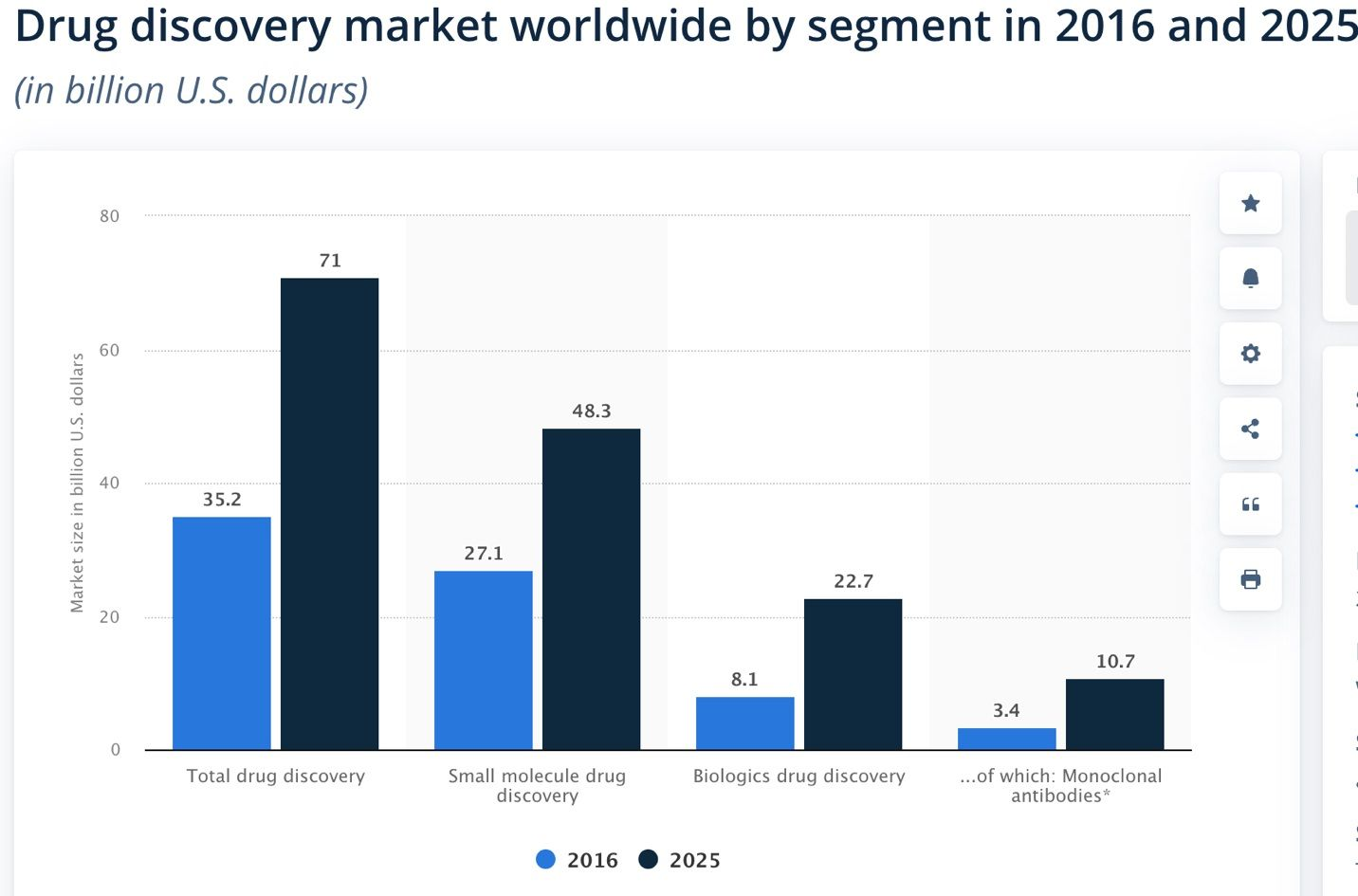
As indicated in the bar graph below, the international drug discovery market has more than doubled in only 9 years – from $35.2 billion in 2016 to $71 billion in 2025. This rapid growth is being driven by remarkable advances in multiple arenas, including gene editing, protein design and, of course, the application of AI to all relevant aspects of the drug discovery process. For example, in 2024, the Nobel Prize in Chemistry was awarded to a team of scientists at DeepMind (Google’s developers of “next generation AI systems”) who had developed AlphaFold, an AI model that can predict protein structure.
“Modeling reaction pathways and electron interactions”, Mr. Severson wrote in October of 2025, “requires handling high-dimensional quantum states where classical density functional theory (DFT) takes days for small molecules.” Consequently, he proceeded to observe that “large-scale simulations (e.g., catalysis for green energy) demand resources beyond classical capabilities, leading to approximations that reduce accuracy.” And that, is precisely where QuantumPulse AI comes in, providing those greater resources to improve accuracy and thereby expedite and improve drug discovery.
For this application specifically, Mr. Severson has identified four components of QuantumPulse AI that elevate its effectiveness above other drug discovery tools: Reflexive memory architecture that enables iterative learning to reduce errors, adaptive quantum solvers to attain faster convergence, hybrid quantum-classical pipeline to improve accuracy, and a no-code interface for chemists to submit complex queries which reduces setup time by 70%. Mr. Severson believes that his invention carries the “potential to reduce lead identification from 12 months to 6 weeks”, thereby “saving $100M–$200M per drug.”
2) Other Health Applications
Beyond drug discovery, QuantumPulse AI is equipped to transform other aspects of healthcare, including the following critical areas:
- Personalized Medicine: By powering quicker and more extensive analysis of patient-specific genomic and microbiomic data, QuantumPulse may be able to enhance treatment efficacy by as much as 35% for diabetes and other chronic conditions.
- Epidemic Response: Quantum-powered AI can model virus mutations (e.g., SARS-CoV-2 variants) for quicker and more targeted vaccine design. These expedited processes reduce vaccine development timelines from years to months by, in Mr. Severson’s words, “simulating protein interactions with quantum precision”.
- Electronic Health Records (EHR): Integrating with EHRs, QuantumPulse AI can optimize predictions regarding specific patients and outcomes. For example, a hospital or healthcare system (a conglomerate of multiple healthcare facilities) could – with the appropriate permissions, of course – integrate its oncology patients’ EHRs with NexPulse’s technology to simulate each patient’s tumor responses to immunotherapy. This would enable more tailored and, ultimately, more effective treatments for patients.
- Rare Disease Research: Just as NexPulse can enhance drug modeling, it can also help model disorders of various sorts. For example, a lab modeling cystic fibrosis can leverage the technology to model protein misfolding with quantum entanglement. AlphaFold, an artificial intelligence program developed by Google/Alphabet’s DeepMind, performs predictions of protein structure so well and so quickly that three of its main scientists were awarded the Nobel Prize for Chemistry in 2024. Enabling even more powerful predictions through QuantumPulse AI would be of enormous value to entities like DeepMind.
- Medical-Related Motion Enhancement:
This application will be addressed at the end of the following section, pertaining to robotics.
3) Robotics
The development and ongoing optimization of new robots/new applications of robotics technology is increasingly reliant on AI. In fact, the two have become so intertwined that the term “physical AI” is used almost interchangeably with robotics, with many field experts seeing the latter as an expression of the former . Notably, the AI juggernaut NVIDIA defines “humanoid robots” as “physical AI-based systems” . Moreover, the company offers a useful disctinction: “Unlike agentic AI”, NVIDIA declared, “which operates in digital environments, physical AI are end-to-end models that can perceive, reason, interact with and navigate the physical world.”
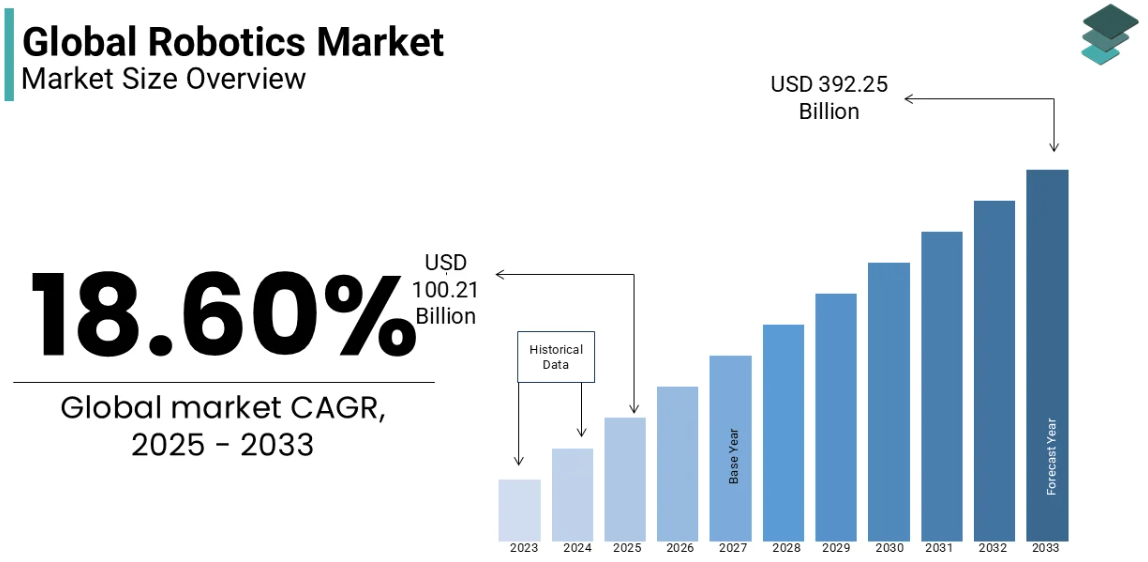
According to the graph below from Market Data Forecast, the global robotics market has now exceeded $100 billion in annual revenue. Defined aptly as the “development of autonomous machines that can perform tasks with human-like capabilities”, robotics is enjoying explosive growth – estimated at an 18.6% compound annual growth rate from 2025 until 2033. In fact, the industry has been growing rapidly for decades:
To illustrate, robotics statistics published in 2025 reveal that over 540,000 industrial robots were installed around the world in 2024 – more than double the 2014 total. Notably, almost three quarters of those 2024 installations occurred in Asia, 16% in Europe and only 9% in all the Americas combined. Unlike many industries, the United States is not the obvious leader in robotics. Indeed, as will be addressed below, some of the most prominent prospective licensees for Mr. Severson – with respect to this particular application – are headquartered internationally, not stateside.
However, the rate of increase in both investment and sales is ramping up considerably in America and, in terms of single country revenue, America will soon generate more robotics sales than any other single country. Much of this investment, both domestically and overseas, pertains to AI. “Generative AI and robotics”, a journalist at MIT (Massachusetts Institute of Technology) News recently exclaimed, “are moving us ever closer to the day when we can ask for an object and have it created within a few minutes.” While the physical matter doing the creating is often the hands of robots, the complex know-how behind the creating is largely the domain of AI.
Much of what drives the complexity of robotics pertains to the complexity of motion tracking and path planning, both of which involve mapping and navigating three-dimensional space in such a way as to enable instantaneous obstacle avoidance and efficient task completion. Considering that the three-dimensional environments in questions are often highly dynamic, with a variety of objects of different sizes moving in and out of the selected path at varying speeds, these tasks require a lot of processing power and tremendous speed, both of which NexPulse has been designed to provide.
In fact, Mr. Severson has developed a module for motion and path analysis, one with specific features to address particular aspects of successful robotics. For example, regarding path planning, Severson’s module includes “Quantum Trajectory Optimization” which, “solves path planning” through the added optimization capabilities of quantum-powered AI. Other relevant features of this QuantumPulse AI module include “real-time 3D motion capture” and “emergent feature detection”
Other Notable Applications/Markets
Finance: AI is already used to process historical data in order to assist with the prediction of market movements and even the movements of specific securities within certain periods. So, it stands to reason that the enhanced quantum-powered AI offered by Mr. Severson would be of considerable value to large trading institutions.
Physics: Software pertaining to physics is often used to perform highly complex simulations. So, it’s precisely the sort of complex digital endeavor for which the quantum-powered benefits of QuantumPulse AI are best suited. Mr. Severson believes that his technology may accelerate discoveries in such realms as condensed matter, particle physics, and quantum phases by as much as 50%.
Engineering: Not unlike the software that is used in physics, software used in all subfields of physics – civil, mechanical, electrical, aerospace, chemical, and biomedical – is often relied upon to perform complex simulations and optimizations. QuantumPulse is designed to deliver significant advancements in both speed and efficiency when it comes to such engineering software tasks as structural simulations and multi-objective optimizations. Such improvements are expected to generate significant savings in the cost-intensive engineering field.
Aerospace: NexPulse can facilitate enormous improvements in computational fluid and other types of modeling for superior aerodynamics.
Energy – Climate Modeling: Leveraging quantum computing for superior climate modeling may lead to faster clean energy breakthroughs and more accurate climate prediction.
Quantum-Power YOUR Company!